
Muktinath Darshan Yatra Guide from India: Routes, Cost, Permits & Itinerary
Planning a Muktinath Darshan Yatra from India involves more than choosing a tour package. The temple is located high in Nepal's Mustang region, where mountain roads, changing weather, limited transport services and high altitude can affect your journey.
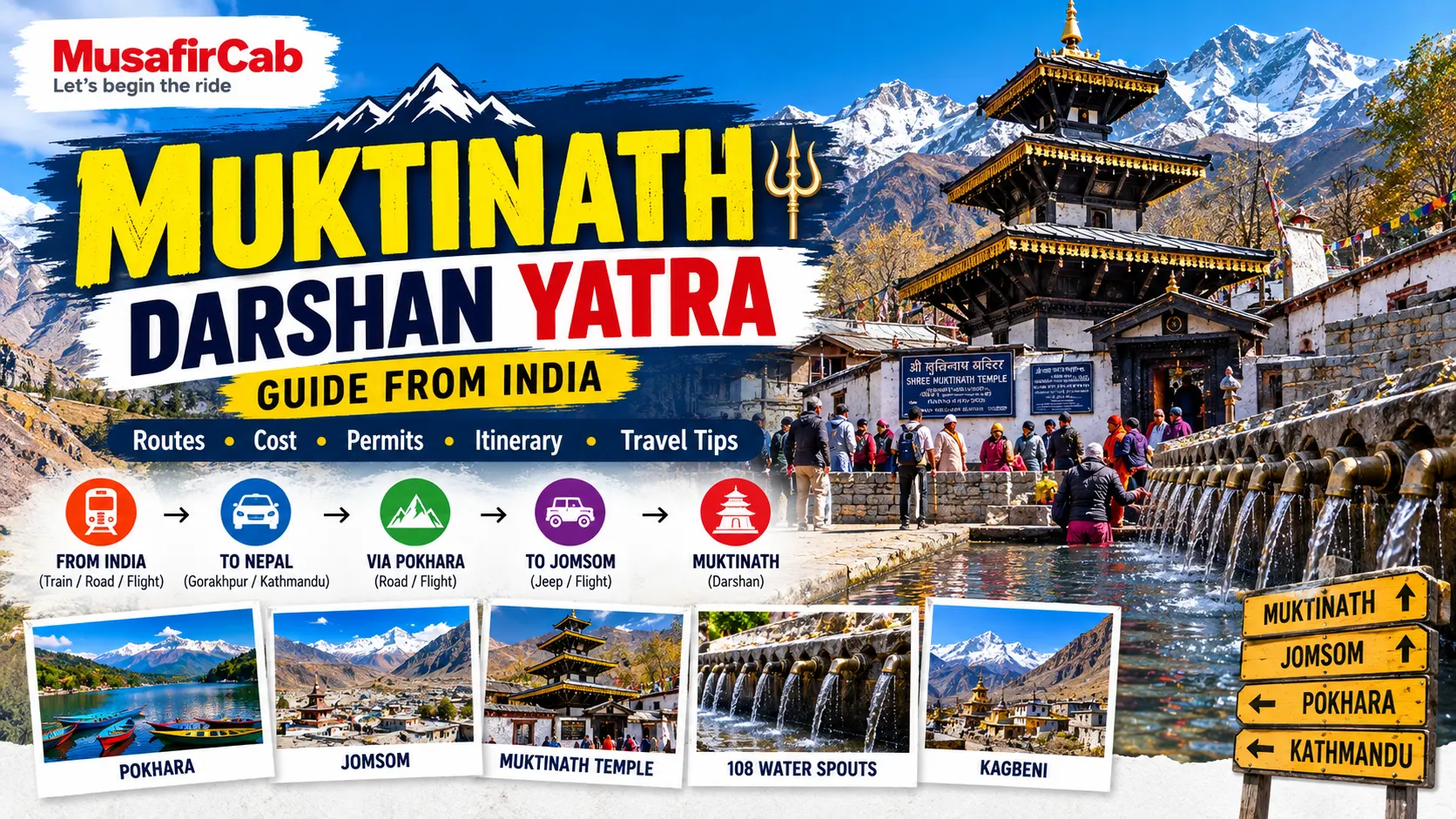
Most Indian pilgrims reach Muktinath through Pokhara, Jomsom and Ranipauwa. Travellers arriving by road from India often enter Nepal through the Gorakhpur–Sunauli route, while those flying into Kathmandu can continue towards Pokhara before beginning the mountain journey.
A successful pilgrimage requires the right route, enough travel days, suitable accommodation, a clear understanding of permits and careful health preparation.
This guide explains how to reach Muktinath, how many days to plan, what expenses to consider, the best time to visit and what families and senior citizens should know before booking.
For a customised journey, explore MusafirCab Nepal Tour Packages and plan your Muktinath pilgrimage around your starting city, available time and travel needs.
Muktinath Darshan Yatra: Quick Travel Information
| Travel detail | Information |
|---|---|
| Temple | Shree Muktinath Temple |
| Location | Mustang district, Nepal |
| Altitude | Approximately 3,700–3,800 metres |
| Main deity | Lord Vishnu |
| Buddhist significance | Chumig Gyatsa |
| Main road gateway | Pokhara via Jomsom |
| Nearby locations | Kagbeni, Ranipauwa, Jomsom |
| Popular Indian pickup gateway | Gorakhpur via Sunauli |
| Main transport options | Jeep/SUV, road transfer, flight plus vehicle |
| Main permit consideration | Annapurna Conservation Area entry |
| Best travel periods | Generally spring and autumn |
| Main travel challenge | High altitude, mountain roads and weather |
Important travel advice: Muktinath is a high-altitude pilgrimage destination. Road access, permit conditions and transport availability should be confirmed before departure.
Why Is Muktinath Temple So Important?
Muktinath Temple is a sacred pilgrimage destination for both Hindus and Buddhists.
For Hindu devotees, the temple is closely associated with Lord Vishnu and the belief in moksha, or liberation from the cycle of birth and death. Pilgrims visit to seek spiritual blessings, offer prayers and participate in traditional rituals.
The temple is also connected with the sacred Kali Gandaki region, where Shaligram stones hold great religious significance.
Buddhists know the site as Chumig Gyatsa, traditionally associated with the sacred waters of the region. The temple complex reflects Nepal's distinctive Hindu–Buddhist spiritual heritage.
Unlike many pilgrimage destinations located within large cities, Muktinath is surrounded by the dramatic landscapes of Mustang, making the journey itself an important part of the experience.
What Makes Muktinath Darshan Special?
The main attractions include:
-
The sacred Lord Vishnu temple
-
The 108 water spouts
-
The holy kunds within the temple complex
-
Jwala Mai Temple and its natural flame
-
Views of the Mustang Himalayan landscape
-
Nearby religious and cultural stops such as Kagbeni
The temple is a place of worship rather than simply a sightseeing attraction. Visitors should respect local customs, follow temple instructions and allow enough time for prayers without rushing.
Where Is Muktinath Temple Located?
Muktinath lies in Nepal's Mustang district, within the Annapurna region, at an elevation commonly described as approximately 3,700–3,800 metres above sea level.
The nearest major tourism hub is Pokhara. The usual road approach follows the Kali Gandaki valley towards Jomsom, Kagbeni and Ranipauwa.
From the vehicle drop-off area near Ranipauwa, pilgrims generally complete the final approach to the temple on foot. Local assistance may be available, but should be checked beforehand rather than assumed.
Understanding the Route
Pokhara → Beni → Tatopani → Ghasa → Jomsom → Kagbeni → Ranipauwa → Muktinath Temple
The journey gradually moves from lower valleys into a much higher mountain environment.
Road quality can vary considerably between sections. Weather, construction, landslides and traffic restrictions may affect travel times.
This is why a Muktinath itinerary should be designed around safe and realistic travel rather than distance alone.
How to Reach Muktinath from India
Indian pilgrims can approach Muktinath by combining railway, road or air travel depending on their starting point.
The main planning decision is how to reach Pokhara. From there, the remaining journey involves mountain transportation towards Jomsom and Muktinath.
Main Travel Options Compared
| Travel option | Suitable for | Main consideration |
|---|---|---|
| Gorakhpur to Pokhara by road | North Indian families and groups | Border crossing and long road journey |
| Kathmandu to Pokhara, then jeep | Pilgrims arriving in Nepal by air | Multiple travel stages |
| Pokhara to Muktinath by jeep | Road pilgrimage groups | Mountain-road conditions |
| Pokhara to Jomsom flight, then jeep | Travellers seeking less road time | Flights are weather-dependent |
| Helicopter arrangement | Travellers considering a specialised service | High cost, weather and altitude risks |
No transport option is universally best. The appropriate choice depends on passengers' health, age, budget, travel dates and willingness to spend time on mountain roads.
Route 1: Gorakhpur to Muktinath via Sunauli
Gorakhpur is a useful starting point for pilgrims arriving from Delhi, Lucknow, Varanasi, Bihar and other Indian cities.
The usual route is:
Gorakhpur → Sunauli → Bhairahawa → Pokhara → Jomsom → Kagbeni → Ranipauwa → Muktinath
Pilgrims commonly reach Gorakhpur by train or flight, then arrange a road transfer towards the Nepal border.
The journey from Gorakhpur to Pokhara is a major travel day. Border procedures, road traffic, rest stops and route conditions can make the trip longer than expected.
The mountain segment from Pokhara should generally be planned separately rather than adding it immediately after a long international road transfer.
This route is especially useful for travellers who want a complete road-based pilgrimage and may also include Lumbini or Pokhara sightseeing.
Route 2: Kathmandu to Muktinath via Pokhara
Travellers arriving at Kathmandu can proceed to Pokhara before travelling towards the Mustang region.
Kathmandu → Pokhara → Jomsom → Kagbeni → Muktinath
Kathmandu and Pokhara can be connected by road or scheduled domestic flight, subject to availability and conditions.
If travelling by road, allow a substantial portion of the day for the Kathmandu–Pokhara transfer. Congestion, road construction and weather can delay arrival.
It is better to stay overnight in Pokhara before starting the onward mountain journey.
This route can also suit a longer Nepal pilgrimage combining Pashupatinath Temple with Muktinath Darshan.
Route 3: Pokhara to Muktinath by Jeep
Pokhara is the main logistical base for many road-based Muktinath pilgrimages.
The approximate road distance to the Muktinath area is commonly around 175–190 km, depending on the route and drop-off point.
However, mountain journeys cannot be estimated using ordinary highway driving speeds.
The route includes areas where roads may be narrow, uneven or affected by seasonal conditions.
A practical road itinerary often includes an overnight halt around Jomsom or another suitable location, rather than attempting the entire journey and return in one exhausting day.
For mountain travel, select a suitable vehicle and driver experienced with local terrain and conditions.
Route 4: Pokhara to Jomsom by Flight
A scheduled flight from Pokhara to Jomsom may reduce time spent on mountain roads.
However, flights in the region can face disruptions because of wind, cloud cover and visibility.
After arriving in Jomsom, pilgrims still need local transportation towards Kagbeni and Ranipauwa.
Flight tickets should not be considered a guarantee of same-day Darshan.
Keep sufficient flexibility in hotel bookings and onward travel plans if choosing this option.
Route 5: Muktinath by Helicopter
Helicopter services may sometimes be arranged for Muktinath-area travel, depending on the operator, operating permissions, weather and available landing arrangements.
Although helicopter travel may reduce journey time, it does not eliminate high-altitude risks.
Rapid ascent can be particularly important for travellers with heart or lung conditions, breathing difficulties or a history of altitude illness.
Helicopter trips should be considered only after evaluating both aviation availability and medical suitability.
Pokhara to Muktinath Road Journey: Detailed Route
The mountain road from Pokhara to Muktinath offers beautiful scenery but requires careful planning.
| Route segment | What to expect |
|---|---|
| Pokhara to Beni | Major road connection towards Myagdi |
| Beni to Tatopani | Kali Gandaki valley approach |
| Tatopani to Ghasa | Mountain roads with varying surfaces |
| Ghasa to Jomsom | Changing terrain and windy valley conditions |
| Jomsom to Kagbeni | Mustang landscape and cultural villages |
| Kagbeni to Ranipauwa | Mountain ascent towards Muktinath |
| Ranipauwa to Temple | Final walking section |
Driving conditions can change quickly. A road that is manageable in dry weather may become much more difficult following heavy rain or local damage.
Is a Normal Car Suitable for Muktinath?
Do not assume every sedan, MPV or tourist cab can travel to Muktinath under all conditions.
Vehicle suitability depends on current road surfaces, ground clearance, load, weather and local operating rules.
A suitable mountain-capable vehicle or a local jeep transfer may be needed for particular sections.
If your Nepal trip includes a sedan or Innova for city transfers, confirm separately whether that vehicle will operate on the Mustang section or whether a change of vehicle is planned.
Before booking, ask: Is the Muktinath jeep included in the package price or charged separately?
Jomsom to Muktinath: Distance, Travel Time and Darshan Access
Jomsom is one of the main transit points for Muktinath pilgrims.
The distance from Jomsom to the Muktinath area is approximately 20–25 km by road, depending on the destination point.
The route normally passes through Kagbeni before climbing towards Ranipauwa.
Travel time can vary because of mountain-road conditions and local stops.
How Far Is the Temple from the Vehicle Drop-off?
Vehicles generally stop at or near the permitted access area around Ranipauwa.
The remaining approach involves walking uphill, with the precise walking distance depending on the drop-off arrangement and local access rules.
At high altitude, even a relatively short walk can feel tiring.
Walk slowly, take breaks when necessary and avoid rushing to complete Darshan.
Assisted transport options or pony services may be available locally, but their availability, permitted routes and prices should be confirmed in advance.
Muktinath Darshan Itinerary: 5, 7 and 9-Day Options
Your ideal itinerary depends on where the trip starts and how much time you can spend travelling.
The following plans are illustrative, not guaranteed schedules. Road, weather, altitude and passenger health conditions may require changes.
5-Day Muktinath Darshan from Gorakhpur
Fast-paced option for travellers with limited time
Day 1: Gorakhpur to Pokhara
Pickup from Gorakhpur and travel towards the Sunauli border. Complete the applicable border procedures before continuing to Pokhara.
This is a long transfer day. Check in to your hotel and rest.
Overnight: Pokhara
Day 2: Pokhara to Jomsom
After an early breakfast, begin the mountain journey through Beni and the Kali Gandaki valley.
The route may include Tatopani, Ghasa and Marpha depending on road access and timing.
Arrive in Jomsom or a suitable nearby halt and rest.
Overnight: Jomsom or an appropriate alternative
Day 3: Muktinath Darshan
Depart for Muktinath via Kagbeni and Ranipauwa.
Visit the temple, perform Darshan and spend time in the sacred complex according to the day's conditions.
Return to Jomsom or another suitable lower-altitude location.
Overnight: Jomsom or a suitable alternative
Day 4: Return to Pokhara
Travel back towards Pokhara via the mountain-road route.
After arrival, enjoy a relaxed evening if time permits.
Overnight: Pokhara
Day 5: Pokhara to Gorakhpur Drop
Check out and begin the return journey through Sunauli.
Complete the border procedures and continue to Gorakhpur for your scheduled drop-off.
Important: This is a demanding itinerary with long travel days. It is not the default recommendation for travellers needing substantial rest, acclimatisation time or medical support.
7-Day Muktinath Yatra from Gorakhpur
More relaxed road-based itinerary
| Day | Travel plan | Overnight |
|---|---|---|
| 1 | Gorakhpur pickup, Sunauli crossing and Lumbini/Bhairahawa transfer | Lumbini or Bhairahawa |
| 2 | Lumbini/Bhairahawa to Pokhara | Pokhara |
| 3 | Pokhara rest, light sightseeing and mountain journey preparation | Pokhara |
| 4 | Pokhara to Jomsom region by suitable vehicle | Jomsom region, subject to fitness |
| 5 | Muktinath Darshan and descent to a suitable overnight halt | As advised by conditions |
| 6 | Return to Pokhara | Pokhara |
| 7 | Pokhara to Gorakhpur drop | — |
This itinerary provides more time for travel than the 5-day option. However, it should not be interpreted as a medically guaranteed acclimatisation schedule.
A rest day in Pokhara, which lies at much lower altitude than Muktinath, does not fully prepare a person for rapid ascent above 3,000 metres.
Travellers at risk of altitude illness may need a substantially slower ascent or a different plan following medical advice.
9-Day Nepal Pilgrimage with Muktinath and Kathmandu
For pilgrims who also want Kathmandu and Pokhara
Day 1: Gorakhpur pickup, border crossing and Lumbini stay.
Day 2: Lumbini to Pokhara, hotel check-in and leisure.
Day 3: Pokhara sightseeing, preparation and rest.
Day 4: Pokhara to Jomsom region, subject to road and health conditions.
Day 5: Muktinath Darshan and return towards a suitable overnight halt.
Day 6: Return to Pokhara.
Day 7: Pokhara to Kathmandu road transfer.
Day 8: Pashupatinath Darshan and selected Kathmandu sightseeing.
Day 9: Kathmandu to Gorakhpur return transfer, if feasible for the passenger group and prevailing road conditions.
The final day is a particularly long international road transfer. An additional night should be considered when passengers need a more comfortable return or have a fixed train or flight connection.
Best Time to Visit Muktinath Temple
Spring and autumn are often preferred for Muktinath Darshan, although no mountain travel season is entirely free of weather risk.
| Season | Typical conditions | Planning advice |
|---|---|---|
| March–May | Spring conditions, still cold at altitude | Popular option; prepare for changing weather |
| June–August | Monsoon impacts on access roads | Allow for landslides, rain and road disruption |
| September–November | Often clearer post-monsoon conditions | Popular pilgrimage period; book transport early |
| December–February | Very cold with potential snow and ice | More challenging, especially for vulnerable travellers |
The best travel period also depends on whether you are travelling by road, domestic flight or helicopter.
Is Muktinath Open Throughout the Year?
The temple is a year-round pilgrimage destination in principle, but actual access and available transport may be disrupted by snow, storms, road closures or other operational restrictions.
Do not interpret year-round religious significance as a guarantee of year-round road accessibility.
Before travelling, verify local conditions and any temple access restrictions.
Muktinath Darshan Cost from India
Muktinath Yatra pricing changes with the pickup city, group size, vehicle type, travel month, accommodation category and mountain transport arrangements.
There is no single reliable package price suitable for every traveller.
What Determines the Total Tour Cost?
| Expense | What to confirm |
|---|---|
| India pickup and drop | Starting city, vehicle and permitted operating route |
| Nepal road transport | Distance, vehicle type, driver and route |
| Mountain jeep | Whether included or separately charged |
| Hotels | City, nights, room type and heating availability |
| Meals | Breakfast, dinner or other meal inclusions |
| Permits | Annapurna Conservation Area and any applicable requirements |
| Flights | Luggage allowance, cancellation and weather policies |
| Darshan logistics | Vehicle drop-off, local assistance and transport |
| Taxes and charges | Applicable local charges and booking terms |
Per-Person Cost vs Full-Vehicle Cost
A per-person package usually spreads transport and accommodation expenses across the number of travellers.
A full-vehicle quotation may be suitable for families or private groups, but it does not automatically include hotels, mountain jeeps or meals.
Ask for these costs to be listed separately.
How to Compare Muktinath Packages
A useful quotation should clarify:
-
Exact pickup and drop-off locations
-
Number of chargeable hotel nights
-
Vehicle models or categories for each route segment
-
Mountain jeep inclusion or exclusion
-
Required conservation-area fees
-
Meals and hotel arrangements
-
Driver allowance, parking and other transport charges
-
Cancellation and weather-disruption policies
-
Passenger assistance requirements
The lowest quotation is not always the most suitable, especially when comparing long mountain journeys.
Is an ACAP Permit Required for Muktinath?
Muktinath lies within the Annapurna Conservation Area, so conservation-area entry requirements must be checked before travel.
The Annapurna Conservation Area Project (ACAP) permit is an important part of planning journeys through this region.
The official NTNC permit portal currently lists an entry fee of NPR 1,000 for SAARC nationals, including Indian citizens, and NPR 3,000 for other foreign nationals, subject to the latest regulations.
Permit validity, the route being used and any exemptions should be confirmed before payment.
A separate restricted-area permit may apply if your itinerary extends into regulated areas such as Upper Mustang. Do not assume an ordinary Muktinath visit automatically requires every Mustang-specific permit.
Where to Check the Permit
Use the official NTNC online permit service:
Keep a copy of your confirmed permit accessible during the journey and follow the instructions given at checkposts.
Documents Required for Indian Pilgrims
Indian nationals generally do not require a visa to visit Nepal.
For air travel between India and Nepal, the standard recognised travel documents are a valid Indian passport or an original voter photo ID issued by the Election Commission of India.
Do not rely on Aadhaar or PAN as an alternative to these documents for international air travel.
For land-border journeys, carry an original passport or voter photo ID where possible and verify the applicable requirements before departure.
Children and senior citizens may have different documentary provisions depending on the route and transport operator.
Additional Documents Worth Carrying
-
Hotel and travel booking confirmations
-
Contact details of the tour coordinator
-
Medical prescriptions and medication details
-
Medical clearance where appropriate
-
Travel insurance policy information
-
Copies of essential identification for backup
-
Relevant vehicle permits and documents if self-driving
Photographs or digital copies can be useful for backup but may not replace original identity documents where originals are required.
Muktinath Altitude Safety: What Every Pilgrim Should Know
Muktinath stands at a height where the amount of available oxygen is significantly lower than at sea level.
Travellers who ascend quickly may experience altitude-related symptoms even if they are otherwise healthy.
Common Warning Signs
These may include:
-
Headache
-
Nausea or loss of appetite
-
Dizziness
-
Unusual fatigue
-
Difficulty sleeping
-
Shortness of breath beyond normal exertion
Symptoms should not automatically be dismissed as tiredness from the road journey.
If altitude-related symptoms develop, do not continue ascending until properly assessed. Worsening symptoms, confusion, difficulty walking normally, breathlessness at rest or persistent coughing require urgent medical attention and descent where appropriate.
Is Muktinath Safe for Senior Citizens?
Many older pilgrims visit Muktinath, but age alone cannot establish medical fitness for a high-altitude journey.
Those with heart or lung disease, breathing disorders, significant mobility limitations or other medical conditions should consult a qualified doctor familiar with high-altitude travel before booking.
A longer itinerary may improve comfort, but it does not remove altitude risk if the ascent remains rapid.
Important Senior Citizen Planning Questions
Before booking, check:
-
Can the traveller comfortably manage the final walking section?
-
Has a doctor reviewed high-altitude suitability?
-
Is a slower ascent required?
-
What is the plan if Darshan cannot be completed?
-
Are suitable overnight stops available?
-
Can the group return to a lower altitude when necessary?
-
What medical and emergency support is realistically accessible?
Avoid promising that a helicopter, oxygen canister or private vehicle automatically makes Muktinath safe for every traveller.
108 Water Spouts and Holy Bath at Muktinath
The 108 water spouts are among the temple's best-known sacred features.
Devotees traditionally pass beneath the flowing water as part of religious observances. The temple complex also contains sacred kunds associated with pilgrimage rituals.
Because the water can be extremely cold, visitors should consider the weather, their physical condition and local temple instructions before participating.
Taking a holy bath is a matter of personal devotion and should not be treated as a compulsory activity for visitors with health limitations.
Those who cannot participate can still approach the pilgrimage with respect and offer prayers according to the applicable temple customs.
What to Pack for Muktinath Darshan
Weather at Muktinath can change rapidly, so packing should balance warmth, comfort and ease of movement.
Clothing and Protection
-
Warm jacket and thermal layers
-
Woollen cap and gloves
-
Comfortable shoes with good grip
-
Wind-resistant outerwear
-
Sunglasses
-
Sunscreen and lip balm
-
Extra socks
-
Suitable rain protection
Personal Essentials
-
Original identity documents
-
Prescribed medicines
-
Drinking water
-
Small snacks
-
Power bank and charging cable
-
Emergency contact information
-
Lightweight daypack
-
Booking and permit details
Do not carry unnecessary luggage on the temple approach.
Pilgrims should also avoid relying entirely on mobile connectivity in remote mountain sections.
Where Should You Stay During Muktinath Yatra?
Accommodation choice matters because the journey passes through locations with different facilities and elevations.
| Place | Main advantage | Consideration |
|---|---|---|
| Pokhara | Wider hotel choice and comfortable facilities | Far from Muktinath |
| Tatopani | Useful road-route halt | Basic options vary |
| Jomsom | Major gateway to Muktinath | Higher altitude and colder conditions |
| Kagbeni | Scenic cultural village | Limited services compared with Pokhara |
| Ranipauwa | Close to the temple | High altitude and basic facilities |
The closest accommodation is not necessarily the best for every traveller.
If someone is experiencing altitude symptoms, sleeping at a higher location can be unsafe. Overnight-stop decisions should consider health and acclimatisation, not simply convenience.
Before booking, ask about heating, hot water, accessibility, stairs, meal arrangements and cancellation terms.
Common Mistakes to Avoid on a Muktinath Yatra
Planning Too Many Destinations
Trying to include Kathmandu, Pokhara, Lumbini, Chitwan and Muktinath in a short road trip can make the journey exhausting.
Focus first on the Darshan and then add sightseeing based on the time available.
Treating Mountain Distance Like Highway Distance
A 180 km mountain journey can require much longer than the same distance on a normal highway.
Keep a realistic schedule and allow for delays.
Ignoring Vehicle Changes
Some tour packages use one vehicle for regular sightseeing and another for the mountain section.
Confirm all transport segments in writing.
Assuming Good Fitness Prevents Altitude Illness
Healthy, active travellers can also experience altitude sickness.
Fitness does not replace acclimatisation.
Booking Tight Return Connections
Bad weather and road delays can affect the return from Mustang.
Avoid scheduling an inflexible international flight or train connection immediately after the mountain journey.
Choosing Hotels Only by Price
Check location, heating, hygiene, available meals and access arrangements.
Not Checking Permit Requirements
Verify conservation-area requirements before entering the Mustang region and keep the necessary permit accessible.
Why Plan Your Muktinath Yatra with MusafirCab?
A Muktinath pilgrimage involves several journey stages, particularly when travelling from India by road.
MusafirCab offers customised Nepal tour planning and can help travellers request arrangements based on their preferred route, available days, passenger count and hotel requirements.
Rather than selecting a standard itinerary blindly, discuss the practical details of your trip before confirming.
What to Discuss with the Tour Team
-
Indian departure and return location
-
Number and ages of passengers
-
Preferred Muktinath travel dates
-
Road journey or flight preference
-
Hotel comfort expectations
-
Private vehicle or group arrangement
-
Mountain transportation requirements
-
Permit and documentation coordination
-
Weather-related backup arrangements
-
Special mobility or assistance needs
All service inclusions, vehicle arrangements, permit handling and support provisions should be confirmed in the final quotation.
Frequently Asked Questions About Muktinath Darshan Yatra
1. How can I reach Muktinath Temple from India?
Most Indian pilgrims travel through Gorakhpur and the Sunauli border or arrive in Kathmandu before continuing to Pokhara. From Pokhara, the journey usually proceeds towards Jomsom, Kagbeni and Ranipauwa by suitable road transport. The final approach to Muktinath Temple is normally completed on foot, depending on local access arrangements.
2. How many days are required for Muktinath Darshan from Gorakhpur?
A five-day road itinerary is possible as a fast-paced plan under favourable conditions, but it can involve exhausting travel days. Seven or more days offer more room for rest, transfers and sightseeing. Travellers needing careful acclimatisation or medical precautions may require additional time or a different itinerary.
3. What is the best time to visit Muktinath?
Spring and autumn are generally preferred for Muktinath Darshan. March to May and September to November may provide more favourable conditions than peak monsoon or winter, but weather is never guaranteed. Always check the current route, forecast and transport status before departure.
4. What is the altitude of Muktinath Temple?
Muktinath is located approximately 3,700–3,800 metres above sea level. At this elevation, some pilgrims may experience altitude illness, particularly after rapid ascent. Travel plans should include appropriate health precautions and medical advice when required.
5. Is Muktinath Darshan suitable for senior citizens?
Some senior citizens can complete the pilgrimage, but suitability depends on medical health, mobility and altitude tolerance. Travellers with heart, lung or other significant medical conditions should obtain professional advice before the trip. Choosing a private vehicle or helicopter does not remove altitude-related risks.
6. How far is Muktinath from Pokhara?
The road journey from Pokhara to the Muktinath area is commonly estimated at approximately 175–190 km, depending on the route and final drop-off point. Mountain conditions make driving times variable. It is generally better to allow a dedicated travel day and appropriate overnight arrangements.
7. How far is Muktinath from Jomsom?
Jomsom is approximately 20–25 km by road from the Muktinath area, depending on the route and exact destination. Pilgrims usually travel through Kagbeni and towards Ranipauwa. The final approach to the temple involves a walking section.
8. Is an ACAP permit required for Muktinath?
Muktinath lies within the Annapurna Conservation Area. Travellers should check the applicable ACAP entry-permit requirements before visiting. The official NTNC permit portal lists NPR 1,000 for SAARC nationals, subject to current rules and any applicable exemptions.
9. Can I visit Muktinath by helicopter?
Helicopter arrangements may be available depending on operator schedules, weather, permits and landing conditions. However, helicopter travel can involve rapid ascent to high altitude. Travellers should evaluate medical suitability as well as flight availability before selecting this option.
10. Is there a direct road from Pokhara to Muktinath?
There is a road route through the Kali Gandaki valley towards Jomsom, Kagbeni and Ranipauwa. However, road surfaces and conditions vary. A suitable mountain vehicle may be required, and temporary disruptions can affect access.
11. Do Indian citizens need a visa for Muktinath Darshan?
Indian citizens generally do not require a visa to enter Nepal. They should carry acceptable original identity documents, such as a valid passport or voter photo ID, and confirm the requirements for their mode of travel.
12. Can Muktinath and Pashupatinath be visited in one trip?
Yes, they can be included in a longer Nepal pilgrimage itinerary. Pashupatinath Temple is located in Kathmandu, while Muktinath is in Mustang. Because both require separate travel stages, a multi-day itinerary is necessary. The total duration depends on the route and transport choices.
13. Is Muktinath open in winter?
Muktinath remains an important pilgrimage destination throughout the year, but winter weather can affect road access and transport services. Snow, ice and extreme cold may make travel difficult, particularly for senior citizens. Check local access conditions before booking.
14. What should I do if Muktinath road travel is cancelled?
Contact your transport provider and assess the current situation before changing the route. Depending on conditions, options may include delaying the mountain journey, adjusting overnight stays or rescheduling Darshan. Avoid attempting a restricted or unsafe road simply to keep the original itinerary.
15. How do I get a Muktinath tour quotation?
Share your pickup city, travel dates, number of passengers, preferred tour duration, hotel category and transport requirements. Also mention any special mobility needs so the travel planner can suggest a more suitable route and provide a quotation with clear inclusions and exclusions.
Plan Your Muktinath Darshan Around Your Time and Comfort
Muktinath is one of Nepal's most meaningful pilgrimage destinations, but the journey deserves careful preparation.
Choosing the right route, allowing enough travel days, confirming accommodation and mountain transport, and understanding altitude risks are more important than trying to complete the yatra as quickly